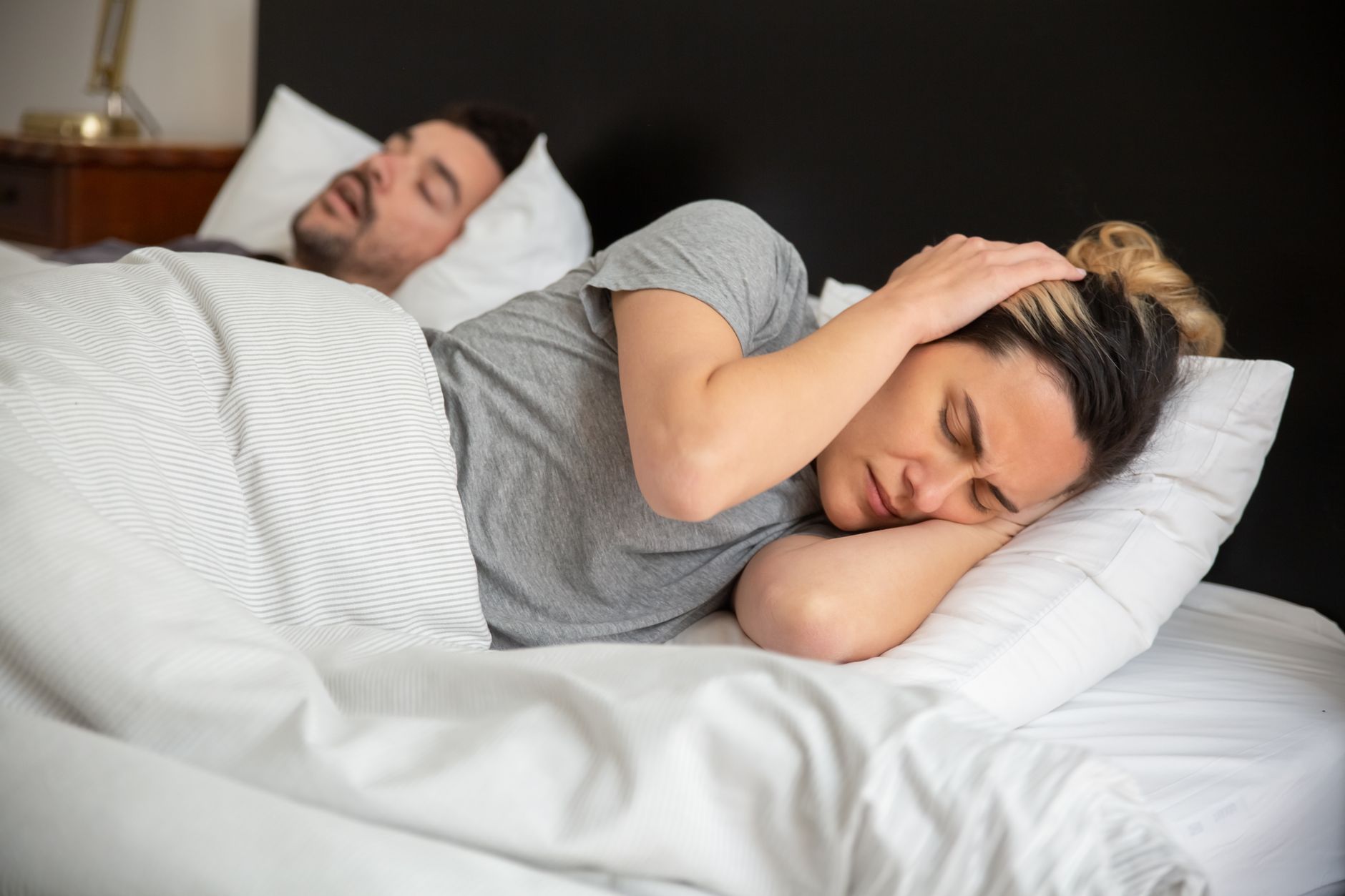
Why people snore: the airway mechanics dentists assess
If you ask “why do I snore,” the answer starts with airway collapse during sleep. Snoring is the acoustic signature of turbulent airflow through a narrowed upper airway. The sound is generated when air velocity increases through a restricted passage, causing vibration of the soft palate, uvula, tongue base, or pharyngeal walls.1
The specific anatomical bottleneck varies. Some people have a long or thick soft palate that sags backward into the airway when supine. Others have a large tongue base that falls posteriorly when throat muscles relax during sleep. A retrognathic (recessed) mandible positions the tongue further back in the pharynx at baseline, leaving less room for airflow.3 Tonsillar hypertrophy, nasal congestion, and excess soft tissue from obesity all compound the problem.
Dentists trained in dental sleep medicine assess these anatomical factors through clinical exam and imaging. They measure the Mallampati score (how much of the pharynx is visible with the tongue out), evaluate jaw position and occlusion, and screen for craniofacial features that predict airway collapse.3 The goal is not just to identify that someone snores, but to map which structures are collapsing and whether the mandible can be advanced to reopen the airway.
Neuromuscular dysfunction of the soft palate and uvula also plays a role. A 2018 systematic review found that people who snore or have obstructive sleep apnea show impaired motor control and increased fatigability of the palatal muscles compared to non-snorers.2 This suggests snoring is not purely a structural problem but a functional one, which is why interventions that physically hold the airway open (like mandibular advancement devices) can be effective even when anatomy is not overtly abnormal.
Why some people snore now when they never used to
The question “why do I snore now when I never used to” points to acquired risk factors. Weight gain is the most common culprit. A 10% increase in body weight can narrow the pharyngeal airway by depositing adipose tissue around the neck and tongue base, raising the risk of snoring and sleep apnea.1 Conversely, weight loss often reduces or eliminates snoring, though the effect is variable and incomplete in people with underlying anatomical narrowing.
Aging contributes independently. Pharyngeal muscle tone declines with age, making the airway more collapsible during sleep. Postmenopausal women see a sharp increase in snoring prevalence, likely due to loss of progesterone’s stimulatory effect on upper airway dilator muscles.1
Alcohol and sedatives worsen snoring by depressing the central nervous system and relaxing the pharyngeal muscles that normally maintain airway patency. Nasal congestion from allergies or structural issues (deviated septum, polyps) forces mouth breathing, which increases airway resistance and turbulence. Sleeping supine (on the back) allows gravity to pull the tongue and soft palate backward, collapsing the airway more than lateral positions do.
Primary snoring is clinically distinct from sleep apnea
Not all snoring is pathological. The German Society of Otorhinolaryngology’s 2015 clinical guideline distinguishes between primary (simple) snoring and snoring caused by obstructive sleep apnea (OSA).4 Primary snoring is habitual snoring without apneic pauses, oxygen desaturation, or daytime symptoms like excessive sleepiness. It is mainly a social nuisance (to the bed partner) rather than a health threat to the snorer.
OSA, by contrast, involves recurrent complete (apnea) or partial (hypopnea) airway collapse during sleep, leading to oxygen drops and fragmented sleep. The clinical consequences include daytime sleepiness, cognitive impairment, hypertension, and elevated cardiovascular risk.1 The severity is quantified by the apnea-hypopnea index (AHI), the number of events per hour of sleep. An AHI of 5 to 15 is mild OSA, 15 to 30 is moderate, and above 30 is severe.
Clinically, you cannot distinguish primary snoring from OSA by loudness or frequency of snoring alone. Polysomnography (an overnight sleep study) or home sleep apnea testing is required to measure AHI and oxygen saturation. This distinction matters because treatment intensity differs. Primary snoring can be managed with lifestyle measures or oral appliances without medical urgency. OSA, especially moderate to severe OSA, requires treatment to reduce cardiovascular and metabolic risk.4
In randomized controlled trials, custom mandibular advancement devices fabricated by dentists outperformed over-the-counter and ready-made oral appliances for both reducing snoring and patient compliance.
What dentists actually prescribe: AADSM protocols for custom appliances
The American Academy of Dental Sleep Medicine (AADSM) published its clinical practice guideline for oral appliance therapy in 2015.5 The guideline recommends custom-fabricated, titratable mandibular advancement devices (MADs) for patients with primary snoring or mild to moderate OSA, and for patients with severe OSA who cannot tolerate CPAP or decline it.
The custom fabrication process begins with dental impressions to create stone models of the upper and lower arches. The appliance is then fabricated in a dental laboratory using thermoplastic or acrylic materials, designed to advance the mandible (lower jaw) forward by 50 to 75% of maximum protrusion.6 This advancement pulls the tongue base and soft palate away from the posterior pharyngeal wall, increasing the anteroposterior dimension of the airway.
Titration is critical. The appliance is adjustable, allowing the dentist to incrementally advance the mandible over several follow-up visits until snoring is eliminated or the AHI is adequately reduced, balanced against side effects like jaw discomfort or tooth movement. A 2025 clinical protocol describes the bibloc (two-piece) MAD fabrication and titration workflow in detail, emphasizing the need for objective follow-up sleep testing to verify therapeutic efficacy.6
The AADSM guideline explicitly states that dentists should not diagnose OSA independently but should work in collaboration with a sleep physician. The sleep physician orders the diagnostic sleep study, interprets the AHI, and prescribes oral appliance therapy if appropriate. The dentist then fabricates and manages the appliance, and orders a follow-up sleep study (with the appliance in place) to confirm that the AHI has normalized.5
This collaborative model is the standard of care in dental sleep medicine. It is not the model that most online retailers of over-the-counter snoring devices follow.
Custom devices outperform over-the-counter options in head-to-head trials
A 2017 randomized controlled trial directly compared custom-made mandibular advancement devices to ready-made (boil-and-bite thermoplastic) devices in 90 patients with OSA.7 The primary outcome was AHI reduction. At three months, the custom device reduced AHI by a mean of 12.1 events per hour, compared to 6.8 events per hour for the ready-made device. The custom device also achieved a significantly higher treatment success rate (defined as AHI below 10 and at least 50% reduction from baseline): 62% versus 41%.
Compliance was higher with the custom device. Patients wore the custom MAD an average of 6.7 hours per night versus 5.5 hours per night for the ready-made device. Discontinuation due to discomfort or ineffectiveness was also lower in the custom group. The authors concluded that while ready-made devices offer a lower-cost entry point, they are inferior in both efficacy and adherence.
A 2024 randomized trial published in JAMA Otolaryngology tested a custom titratable MAD specifically for primary snoring (not OSA).8 The trial compared the MAD to a combined intervention (nasal dilator strips plus positional therapy). The MAD group showed greater reductions in snoring frequency and loudness, measured both objectively (via acoustic recording) and subjectively (by bed partner report). Importantly, this trial enrolled patients with isolated snoring, confirming that mandibular advancement is effective even in the absence of apnea.
The performance gap between custom and over-the-counter devices comes down to precision and titration. Over-the-counter devices are one-size-fits-all or crudely adjustable. They do not account for individual variation in jaw anatomy, dental occlusion, or the optimal degree of mandibular advancement. Custom devices are fabricated to fit the patient’s exact dental anatomy and allow controlled, incremental advancement until the therapeutic endpoint is reached.
| Feature | Custom MAD | Over-the-counter (OTC) |
|---|---|---|
| Fabrication | Dental impressions, lab-fabricated to patient anatomy | Boil-and-bite thermoplastic or pre-sized generic fit |
| Titration | Incrementally adjustable by dentist over multiple visits | Fixed or limited user adjustment, no clinical titration |
| RCT efficacy data | AHI reduction 12.1 events/hour, 62% treatment success (Johal 2017) | AHI reduction 6.8 events/hour, 41% treatment success (Johal 2017) |
| Compliance | 6.7 hours per night mean wear time | 5.5 hours per night mean wear time |
| Side effects | Temporary jaw soreness, salivation, rare tooth movement (monitored) | Higher discontinuation due to discomfort, poor fit |
| Cost | $1,500 to $3,000 (often partially covered by insurance) | $50 to $150 |
| Follow-up | Dentist follow-up, repeat sleep study to verify efficacy | No clinical follow-up, no objective efficacy verification |
Custom mandibular advancement devices versus over-the-counter devices. Data from Johal et al. 2017 randomized trial.
The table makes the trade-off explicit. You are paying for precision, supervised titration, and verified efficacy. The online stores selling $60 boil-and-bite devices do not mention that head-to-head trials show a 50% higher failure rate compared to custom appliances.
How oral appliances compare to CPAP in clinical trials
Continuous positive airway pressure (CPAP) remains the first-line therapy for moderate to severe OSA. CPAP delivers pressurized air through a nasal or full-face mask, pneumatically splinting the airway open. It is highly effective at eliminating apneas and normalizing AHI, often reducing AHI to below 5 events per hour regardless of baseline severity.
Oral appliances are less effective than CPAP at reducing AHI in head-to-head comparisons, but the gap in real-world effectiveness is smaller than the gap in controlled efficacy, because CPAP compliance is poor. A 2025 meta-analysis pooled data from multiple RCTs comparing oral appliance therapy to CPAP.9 CPAP reduced AHI by a mean of 25 events per hour more than oral appliances. However, nightly adherence to CPAP averaged only 4 to 5 hours in many trials, whereas oral appliance adherence was 6 to 7 hours. When efficacy is weighted by actual hours of use, the real-world benefit gap narrows.
Oral appliances also show cardiovascular benefit in severe OSA, though the evidence is thinner than for CPAP. A 2017 trial in patients with severe OSA found that three months of mandibular advancement therapy improved endothelial function (a marker of cardiovascular health) to a similar degree as CPAP.10 This suggests that even in severe disease, oral appliances offer meaningful physiological benefit, particularly in patients who cannot tolerate CPAP.
Side effects differ. CPAP causes nasal congestion, mask discomfort, claustrophobia, and aerophagia (air swallowing). Oral appliances cause jaw soreness, excessive salivation, dry mouth, and occlusal changes (tooth movement) with long-term use. A 2025 meta-analysis of mandibular advancement device side effects found that most are mild and transient, resolving within weeks to months of initiating therapy.11 Long-term occlusal changes are measurable but rarely severe enough to require orthodontic correction.11
The AADSM guideline recommends oral appliances as a first-line option for patients with primary snoring or mild to moderate OSA, and as a second-line option for patients with severe OSA who refuse or cannot tolerate CPAP.5 This is not a one-size-fits-all hierarchy. The best therapy is the one the patient will actually use.
When to see a dentist versus when to see a sleep specialist
If you are asking “why do I snore so loud” or “how can I stop snoring,” the clinical pathway depends on whether you have symptoms beyond the snoring itself. Loud snoring alone, without witnessed apneas, gasping, or daytime sleepiness, suggests primary snoring. In this case, lifestyle measures are first-line: lose weight if overweight, avoid alcohol before bed, treat nasal congestion, and sleep on your side instead of your back.4
If lifestyle measures fail or are insufficient, an oral appliance is reasonable for primary snoring. You can start with an over-the-counter device, but if it does not work or is uncomfortable, see a dentist trained in dental sleep medicine for a custom appliance. Primary snoring does not require a sleep study unless you want objective confirmation that you do not have OSA.
If you have witnessed apneas (your bed partner sees you stop breathing), choking or gasping during sleep, or severe daytime sleepiness, you need a sleep study to measure AHI and rule out OSA. Start with your primary care physician or go directly to a sleep medicine specialist. Do not self-diagnose with an over-the-counter device. OSA is a medical condition with cardiovascular and metabolic consequences, and treatment intensity should match disease severity.
If the sleep study confirms OSA, the treatment pathway depends on AHI and patient preference. Mild OSA (AHI 5 to 15) can be treated with lifestyle measures, oral appliances, or CPAP. Moderate OSA (AHI 15 to 30) is typically treated with CPAP first, but oral appliances are a reasonable alternative if CPAP is refused or not tolerated. Severe OSA (AHI above 30) should be treated with CPAP unless the patient absolutely cannot tolerate it, in which case a custom oral appliance is preferable to no treatment.5
The dentist’s role is to fabricate and titrate the appliance, not to diagnose OSA. The sleep physician’s role is to diagnose OSA, determine severity, prescribe therapy, and verify efficacy with follow-up testing. This division of labor is the standard of care. Online retailers who sell snoring devices without requiring a sleep study or physician involvement are bypassing this pathway entirely.
Where to buy (with honest caveats)
Custom mandibular advancement devices fabricated by a dentist cost $1,500 to $3,000 and require multiple office visits for fitting and titration. Insurance may cover part of the cost if you have a diagnosis of OSA from a sleep study. If you cannot access dental sleep medicine, over-the-counter devices like SnoreRX ($60, titratable boil-and-bite MAD) or ZQuiet ($49.99, hinged MAD) may provide partial benefit for primary snoring.
The caveat: clinical trials show that over-the-counter devices are less effective and less well-tolerated than custom devices. The 2017 Johal trial found a 62% treatment success rate for custom MADs versus 41% for ready-made devices.7 You are more likely to abandon an OTC device due to poor fit or lack of noticeable improvement. If you try an OTC device and it does not work, that does not mean oral appliance therapy will not work. It may mean you need a custom appliance with proper titration.
If you have moderate to severe OSA (AHI above 15), do not rely on an over-the-counter device without follow-up testing. The stakes are higher, and you need objective verification that your AHI is adequately reduced. Work with a sleep physician and a dentist, not an online store.
SnoreRX (Titratable boil-and-bite MAD, 1 mm incremental adjustment). Where to buy →
Sources
- Jordan AS, et al. Adult obstructive sleep apnoea. Lancet, 2014. PubMed
- Patel JA, et al. Neuromuscular function of the soft palate and uvula in snoring and obstructive sleep apnea: A systematic review. Am J Otolaryngol, 2018. PubMed
- Masoud AI, et al. Sleep and airway assessment: A review for dentists. Cranio, 2017. PubMed
- Stuck BA, et al. Diagnosis and treatment of snoring in adults-S2k Guideline of the German Society of Otorhinolaryngology, Head and Neck Surgery. Sleep Breath, 2015. PubMed
- Ramar K, et al. Clinical Practice Guideline for the Treatment of Obstructive Sleep Apnea and Snoring with Oral Appliance Therapy: An Update for 2015. J Clin Sleep Med, 2015. PubMed
- Wakam R, et al. Step-by-step clinical protocol for the fabrication and titration of a bibloc mandibular advancement device: a practical guide for sleep physicians. Sleep Breath, 2025. PubMed
- Johal A, et al. Ready-Made Versus Custom-Made Mandibular Repositioning Devices in Sleep Apnea: A Randomized Clinical Trial. J Clin Sleep Med, 2017. PubMed
- Ioerger P, et al. Mandibular Advancement vs Combined Airway and Positional Therapy for Snoring: A Randomized Clinical Trial. JAMA Otolaryngol Head Neck Surg, 2024. PubMed
- Gao Y, et al. Comparative efficacy of sleep positional therapy, oral appliance therapy, and CPAP in obstructive sleep apnea: a meta-analysis of mean changes in key outcomes. Front Med (Lausanne), 2025. PubMed
- Gagnadoux F, et al. Impact of Mandibular Advancement Therapy on Endothelial Function in Severe Obstructive Sleep Apnea. Am J Respir Crit Care Med, 2017. PubMed
- Wang X, et al. Comparison of side effects of different mandibular advancement devices for patients with obstructive sleep apnea: a systematic review and meta-analysis. J Clin Sleep Med, 2025. PubMed
- Marklund M, et al. Daytime sleepiness estimated using the Karolinska Sleepiness Scale during mandibular advancement device therapy for snoring and sleep apnea: a secondary analysis of a randomized controlled trial. Sleep Breath, 2025. PubMed