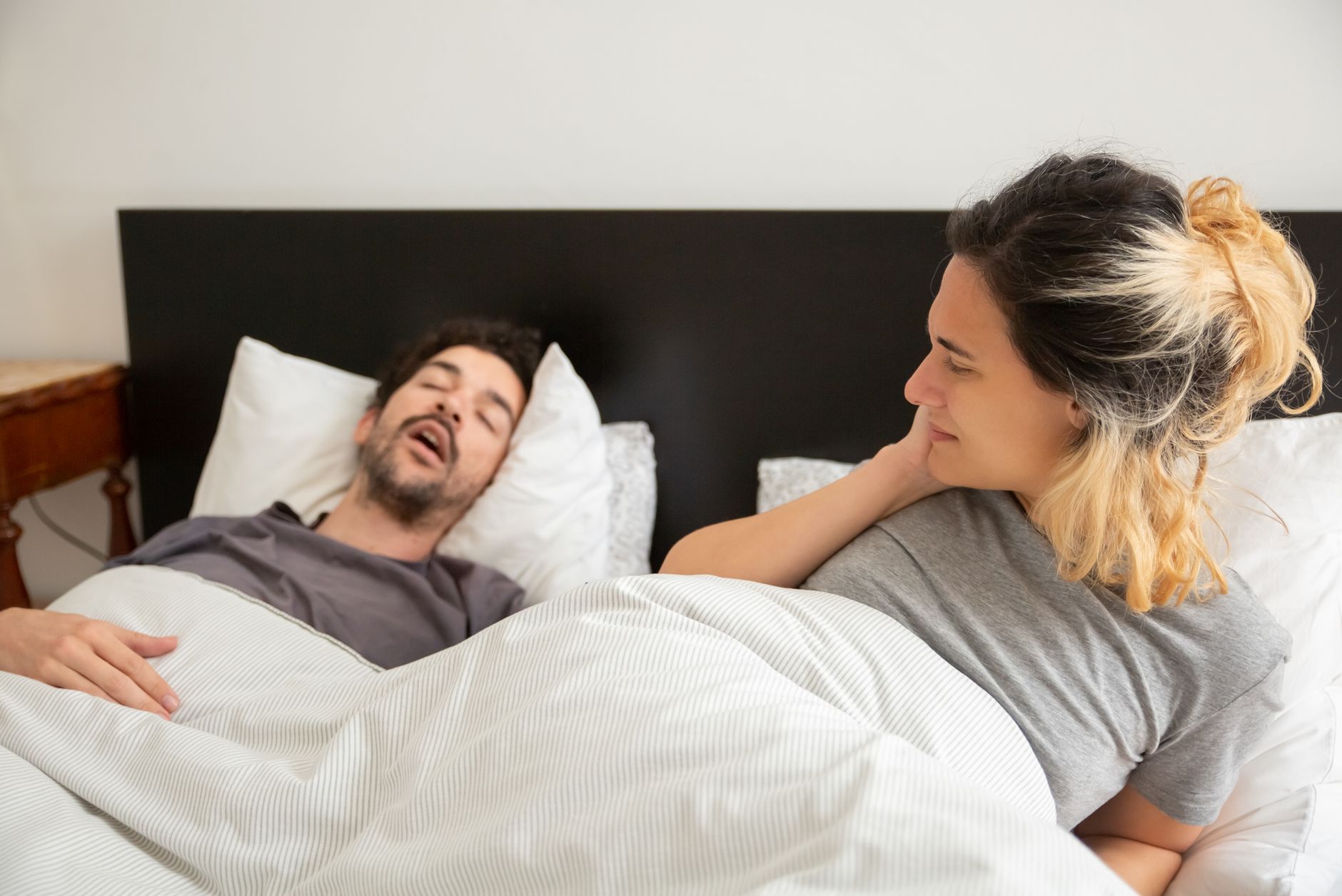
Most people frame snoring as either a nuisance or a sign of sleep apnea. The truth sits between those poles. Snoring causes fall into three categories (behavioral, anatomical, systemic), and the clinical evidence now shows that chronic snoring carries cardiovascular risk even when no apnea is present. This review explains what makes you snore, how to tell benign snoring from a warning pattern, and which self-assessment tools predict apnea risk accurately enough to guide next steps.
Three types of snoring causes, and how to tell them apart
Snoring happens when airflow vibrates relaxed tissue in the throat. The reasons for snoring divide into three overlapping categories.
Behavioral causes are situational. Alcohol relaxes throat muscles. 3 Back-sleeping narrows the airway. Weight gain deposits pharyngeal fat. 7 These causes respond to changes in habit or lifestyle.
Anatomical causes are structural. A large tongue base, a long soft palate, a recessed jaw, or enlarged tonsils physically narrow the airway. 8 9 Imaging studies show that snorers without apnea often have smaller retropalatal and retroglossal spaces than non-snorers. 10 These causes usually require a device (oral appliance, positional trainer) or surgery to resolve.
Systemic causes involve aging and hormonal shifts. Snoring prevalence increases with age in both sexes, but the slope is steeper in women after menopause. 6 The mechanism is thought to involve declining muscle tone and changing fat distribution, though the evidence base remains thin.
Most chronic snorers have more than one cause operating at once. A 45-year-old man who snores only after two drinks and only on his back has a behavioral pattern. A 55-year-old woman whose snoring started at menopause and happens in all positions likely has anatomical and systemic contributors.
Behavioral snoring causes are the easiest to fix
Three behavioral triggers dominate the literature.
Alcohol. A 2020 meta-analysis found that alcohol consumption increased snoring frequency and severity across six studies. 3 The effect size was consistent: habitual drinkers snored more than abstainers, and drinking within three hours of sleep worsened snoring in people who already snored. The mechanism is muscle relaxation, the same reason sedatives and benzodiazepines exacerbate sleep apnea.
Sleep position. Back-sleeping (supine position) lets the tongue fall backward and narrows the airway. A 2017 RCT tested a cervical pillow designed to keep the head elevated and slightly turned. The pillow reduced snoring frequency by 30% compared to a standard pillow. 4 A 2024 JAMA trial compared mandibular advancement devices to combined positional therapy (a device that vibrates when you roll onto your back) and found positional therapy alone reduced snoring in 60% of participants. 5 The effect is real but partial: most people who snore in all positions won’t eliminate snoring by sleeping on their side, though they may reduce it.
Weight. Pharyngeal fat accumulates with weight gain and narrows the upper airway even in people without obesity. 7 A 10% weight gain correlates with a 3-fold increase in apnea risk, and snoring precedes apnea on that continuum. Weight loss reverses the pattern, though the evidence for snoring reduction specifically (as opposed to apnea reduction) is sparse. Most weight-loss studies measure apnea-hypopnea index, not snoring sound or frequency.
Popular belief holds that nasal congestion is a major snoring cause. The evidence is weak. Nasal strips and decongestants reduce nasal resistance but don’t reliably reduce snoring unless the person has documented nasal obstruction and no other contributing factors. The sound originates in the throat, not the nose, for most snorers.
Anatomy blocks the airway in predictable ways
Imaging and surgical case series identify five anatomical choke points. 10 12
Soft palate and uvula. The soft palate is the most common site of snoring vibration. People with a long uvula or redundant palatal tissue have more surface area to vibrate. A 2018 systematic review found that snorers show reduced neuromuscular control of the soft palate compared to non-snorers, even during wakefulness. 8 The tissue is both larger and less tonically active.
Tongue base. A large tongue or posterior tongue position narrows the oropharyngeal airway. Cephalometric studies (lateral skull X-rays) show that people with apnea have longer tongue measurements and smaller posterior airway spaces than matched controls. 9 The pattern holds across ethnic groups, though the magnitude varies (Asian populations show more retrognathia, Western populations show more obesity-related tongue size increase).
Jaw alignment (retrognathia). A recessed lower jaw (mandible) positions the tongue farther back. A 2017 meta-analysis of cephalometric studies found that apnea patients had, on average, a 4.5 mm shorter mandibular body length and a 3.2 mm more posterior tongue base than controls. 9 Snoring without apnea shows the same pattern but with smaller effect sizes. Mandibular advancement devices work by pulling the jaw (and tongue) forward. A 2023 network meta-analysis confirmed they reduce snoring and apnea severity, though not all users tolerate them. 13
Epiglottic collapse. In some people the epiglottis folds backward during inspiration and partially blocks the airway. A 2016 systematic review found epiglottic collapse in 20 to 30% of apnea patients undergoing drug-induced sleep endoscopy. 11 The prevalence in simple snorers (no apnea) is unknown but thought to be lower. This pattern doesn’t respond to positional therapy or oral appliances and usually requires surgical intervention if it’s causing symptoms.
Eustachian tube dysfunction. A 2025 systematic review noted that chronic snoring and apnea patients have higher rates of Eustachian tube dysfunction, possibly due to chronic negative pharyngeal pressure during sleep. 17 The dysfunction can worsen nasal congestion and create a cycle. This is an emerging research area and not yet part of routine snoring assessment.
Chronic snoring carries cardiovascular risk, even without apnea
Popular advice treats snoring without apnea as harmless. The emerging evidence contradicts this.
A 2024 umbrella review of 200 observational studies and Mendelian randomization trials found that habitual snoring (defined as snoring most nights) is independently associated with hypertension, heart failure, and stroke, even after adjusting for apnea, BMI, and smoking. 14 The effect sizes are smaller than for apnea but statistically robust. The review authors concluded that snoring should be treated as a cardiovascular risk factor on its own, not merely as a marker for possible apnea.
The mechanism appears to involve repetitive intrathoracic pressure swings, sympathetic nervous system activation, and endothelial dysfunction. A 2024 systematic review on heart failure and sleep-disordered breathing found that even primary snoring (snoring without oxygen desaturation or arousals) produces measurable increases in heart rate variability and blood pressure during sleep. 15 Over years this translates to structural changes: left ventricular hypertrophy, atrial enlargement, and diastolic dysfunction.
A 2024 review on pulmonary hypertension found that chronic snoring is associated with elevated pulmonary artery pressures independent of apnea diagnosis. 16 The authors noted that most snorers are not screened for pulmonary hypertension and that the condition may be under-diagnosed in this population.
This does not mean every person who snores will develop heart disease. It means that snoring is not benign background noise. If you snore most nights and have other cardiovascular risk factors (hypertension, family history, sedentary lifestyle), treating the snoring is not purely cosmetic.
Four self-assessment tools let you screen at home
Why do people snore at levels that warrant medical evaluation? The line between simple snoring and obstructive sleep apnea is clinically meaningful because apnea has clear treatment pathways (CPAP, oral appliances, surgery) with proven efficacy. Four questionnaires predict apnea risk with validated accuracy.
| Tool | Questions | What it measures | Sensitivity / Specificity | Best for |
|---|---|---|---|---|
| STOP-BANG | 8 yes/no | Snoring, tiredness, observed apnea, blood pressure, BMI, age, neck size, gender | 90% / 50% (high sensitivity, many false positives) | Ruling out apnea (if score is low, apnea is unlikely) |
| Berlin | 10 items, 3 categories | Snoring frequency, tiredness, blood pressure, BMI | 70% / 60% (balanced) | General screening in primary care |
| Epworth Sleepiness Scale | 8 scenarios, 0-3 scale | Daytime sleepiness likelihood in specific situations | 60% / 70% (modest, measures sleepiness not apnea directly) | Gauging functional impact, not diagnosis |
| STOP (simplified) | 4 yes/no | Snoring, tiredness, observed apnea, blood pressure | 80% / 45% (high sensitivity, lower than STOP-BANG) | Quick screen when time is limited |
Self-assessment tool comparison from Chiu 2017 and Li 2024 meta-analyses
A 2017 bivariate meta-analysis pooled 108 studies and found that STOP-BANG has the highest sensitivity (it catches the most apnea cases) but generates many false positives. 1 Berlin has better balance. Epworth is widely used but predicts sleepiness, not apnea directly, and many apnea patients score low on Epworth if they’ve adapted to chronic fatigue.
A 2024 comprehensive meta-analysis confirmed these rankings and added that combining two tools (for example, STOP-BANG for sensitivity and Berlin for specificity) improves overall diagnostic utility but adds questionnaire burden. 2 For home use, STOP-BANG is the most practical starting point. A score of 3 or higher (out of 8) suggests moderate to high apnea risk and justifies a sleep study referral.
None of these tools diagnose snoring causes. They predict apnea risk. If your score is low and you snore loudly every night, you likely have simple snoring (caused by behavioral or anatomical factors), not apnea. If your score is high, apnea is likely and you need formal testing (polysomnography or home sleep apnea test).
These patterns suggest sleep apnea, not simple snoring
Four patterns distinguish apnea from simple snoring with reasonable reliability.
Witnessed breathing pauses. If a bed partner reports that you stop breathing for 10 seconds or longer during sleep, that is by definition apnea (or hypopnea if airflow is reduced but not absent). Simple snoring doesn’t include pauses. This is the single most predictive symptom.
Gasping or choking. Waking up gasping or choking suggests an arousal triggered by oxygen desaturation or carbon dioxide buildup. Simple snoring may wake a bed partner but rarely wakes the snorer unless the sound is extraordinarily loud.
Morning headaches. Frequent morning headaches, especially if they resolve within an hour of waking, suggest nocturnal hypoxia or hypercapnia. Simple snoring doesn’t cause headaches unless you’ve been sleeping with your mouth open and have severe dry mouth or sinus congestion.
Non-restorative sleep with normal sleep duration. If you sleep 7 to 8 hours and wake up exhausted, apnea is more likely than simple snoring. Simple snoring can disrupt a bed partner’s sleep but usually doesn’t fragment the snorer’s own sleep enough to cause daytime impairment unless volume is extreme.
Why do I snore now when I never used to? New-onset snoring in adulthood usually signals weight gain, aging, or both. Women often report snoring onset at menopause. If snoring appears suddenly and is accompanied by any of the four patterns above, screen for apnea with STOP-BANG. If the snoring is new but you have none of the apnea patterns, review behavioral causes (alcohol, sleep position, recent weight change) first.
What to tell your doctor about your snoring
Bring three pieces of information to a medical visit.
Frequency and duration. How many nights per week do you snore? Has it been happening for months or years? Intermittent snoring (a few nights per month) rarely justifies testing unless it’s tied to apnea symptoms. Nightly snoring for six months or longer is clinically significant.
Witnessed symptoms. Does anyone observe breathing pauses, gasping, or choking? If yes, state the frequency (nightly, weekly, rarely). This single observation will prompt most physicians to order a sleep study.
Functional impact. Do you wake unrefreshed? Fall asleep during the day unintentionally? Have trouble concentrating? These symptoms, combined with habitual snoring, meet clinical criteria for a sleep disorder evaluation.
Your doctor will likely ask about alcohol use, sleep position, weight change, and family history. If apnea is suspected, the next step is a sleep study (in-lab polysomnography or home sleep apnea test). If simple snoring is more likely, behavioral interventions (positional therapy, weight loss, alcohol reduction) are tried first. Oral appliances and surgical options are reserved for cases where behavioral measures fail and the snoring is causing significant distress or cardiovascular risk.
The cardiovascular evidence means that “it’s just snoring” is no longer an adequate dismissal. If you snore most nights and have other risk factors, treating the snoring is a cardiovascular intervention, not a cosmetic one.
Sources
- Chiu HY, et al. Diagnostic accuracy of the Berlin questionnaire, STOP-BANG, STOP, and Epworth sleepiness scale in detecting obstructive sleep apnea: A bivariate meta-analysis. Sleep Med Rev, 2017. PubMed
- Li X, et al. Diagnostic utility of obstructive sleep apnea screening questionnaires: a comprehensive meta-analysis. Sleep Breath, 2024. PubMed
- Burgos-Sanchez C, et al. Impact of Alcohol Consumption on Snoring and Sleep Apnea: A Systematic Review and Meta-analysis. Otolaryngol Head Neck Surg, 2020. PubMed
- Cazan D, et al. The effect on snoring of using a pillow to change the head position. Sleep Breath, 2017. PubMed
- Ioerger P, et al. Mandibular Advancement vs Combined Airway and Positional Therapy for Snoring: A Randomized Clinical Trial. JAMA Otolaryngol Head Neck Surg, 2024. PubMed
- Chan CH, et al. Gender difference in snoring and how it changes with age: systematic review and meta-regression. Sleep Breath, 2012. PubMed
- Pahkala R, et al. The impact of pharyngeal fat tissue on the pathogenesis of obstructive sleep apnea. Sleep Breath, 2014. PubMed
- Patel JA, et al. Neuromuscular function of the soft palate and uvula in snoring and obstructive sleep apnea: A systematic review. Am J Otolaryngol, 2018. PubMed
- Neelapu BC, et al. Craniofacial and upper airway morphology in adult obstructive sleep apnea patients: A systematic review and meta-analysis of cephalometric studies. Sleep Med Rev, 2017. PubMed
- Chen H, et al. Three-dimensional imaging of the upper airway anatomy in obstructive sleep apnea: a systematic review. Sleep Med, 2016. PubMed
- Torre C, et al. Epiglottis collapse in adult obstructive sleep apnea: A systematic review. Laryngoscope, 2016. PubMed
- Bosi M, et al. The importance of obstructive sleep apnoea and hypopnea pathophysiology for customized therapy. Eur Arch Otorhinolaryngol, 2017. PubMed
- Iftikhar IH, et al. Comparative efficacy of mandibular advancement devices in obstructive sleep apnea: a network meta-analysis. Sleep Breath, 2023. PubMed
- Yang C, et al. Associations of sleep with cardiometabolic risk factors and cardiovascular diseases: An umbrella review of observational and mendelian randomization studies. Sleep Med Rev, 2024. PubMed
- Polecka A, et al. Rostral fluid shifts and other mechanisms of interaction between obstructive sleep apnea and heart failure - a systematic review. Otolaryngol Pol, 2024. PubMed
- Battaglia E, et al. Pulmonary hypertension in patients affected by sleep-related breathing disorders: up to date from the literature. Minerva Med, 2024. PubMed
- Moffa A, et al. Eustachian tube dysfunction in obstructive sleep apnea patients: implications for a multimodal treatment approach. A systematic review. Sleep Breath, 2025. PubMed